 how-to
How to Prepare for HYROX Race at Home
Table of Contents
- Can You Prepare for HYROX at Home?
- Building Your At-Home HYROX Equipment List
- Creating Your HYROX Workout Plan for Beginners
- HYROX Training Duration for Beginners
- Running and Pacing Strategy for HYROX
- HYROX Race Simulation Workouts at Home
- Injury Prevention, Recovery, and Nutrition
- Frequently Asked Questions
Last Updated: October 1, 2026
Can You Prepare for HYROX at Home?
Yes, you can prepare for hyrox race at home. Many athletes train successfully for HYROX races without access to a full commercial gym. The key is understanding what the race demands and building a training plan that replicates those demands using equipment you can find or create at home.
HYROX is an 8-kilometer obstacle course race with eight workout stations (The Fitness Race). It combines running with functional fitness movements. At Warrior Welke CrossFit l/Hyrox, we help athletes train for HYROX races by breaking down the race format and creating scalable programming.
The race includes compromised running between stations, wall balls, sled pushes and pulls, burpee broad jumps, lunges, rowing, and ski erg work. You don't need all these machines at home. What you need is a solid plan that uses creative alternatives and progressive overload to build the aerobic capacity and functional strength HYROX demands.
Building Your At-Home HYROX Equipment List
Essential Gear You'll Need
A basic HYROX home setup requires five core pieces of equipment. You can start with just two or three and add more as your training progresses.
Must-have equipment:
- Dumbbells or kettlebells (20-50 pounds)
- Resistance bands (various resistance levels)
- A pull-up bar or suspension trainer
- A jump rope or open space for cardio
- A water jug or sandbag (20-40 pounds)
These five items cover 80% of HYROX training needs. Dumbbells build strength for wall balls and lunges. Resistance bands add challenge to movements and improve metabolic demand. A pull-up bar develops upper-body pulling power. Jump rope builds footwork and aerobic capacity. A water jug or sandbag replaces sled work and adds functional load.
Start with what fits your budget. Many athletes begin with just dumbbells and a resistance band. Add equipment as your training progresses.
DIY Equipment Hacks for Home Training
You don't need expensive machines to train for HYROX at home. Creative alternatives work just as well.
DIY sled push and pull: Use a sturdy chair or furniture slider. Load it with weight (dumbbells, books, or water jugs). Push it across your floor or driveway.
Creating Your HYROX Workout Plan for Beginners
Weekly Training Structure and Splits
A beginner HYROX training plan runs 12-16 weeks. It balances running, strength, and metabolic conditioning across four to five training days per week.
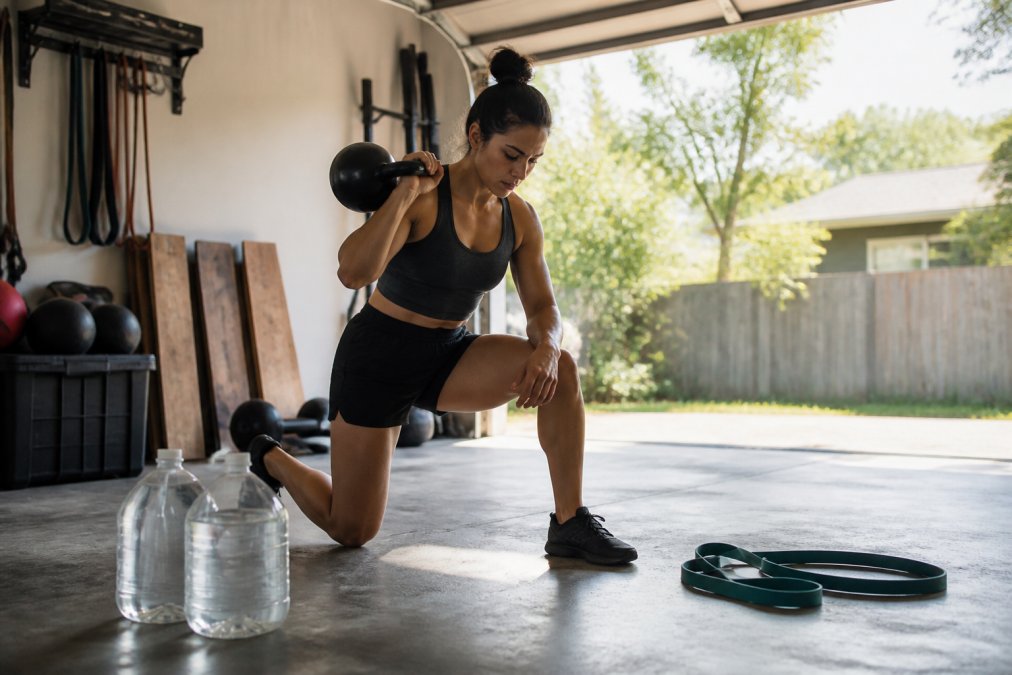
Weekly structure:
- Monday: Strength and power (squats, deadlifts, upper-body work)
- Tuesday: Running or aerobic work (steady state or interval training)
- Wednesday: Rest or mobility work
- Thursday: Metabolic conditioning (EMOM or descending ladder format)
- Friday: Running and compromised running practice
- Saturday: Long run or race simulation
- Sunday: Rest or recovery
Progressive Overload for Bodyweight Athletes
Progressive overload means making training harder over time. Without a gym, you use different methods.
Methods for progressive overload:
- Add weight (dumbbells, water jugs, backpacks)
- Increase reps or sets
- Reduce rest time between sets
- Improve movement quality or range of motion
- Increase running speed or distance
- Add complexity (single-leg work, uneven loads)
HYROX Training Duration for Beginners
Timeline to Race Readiness
Most beginners need 12-16 weeks to prepare for hyrox race. This timeline assumes you have a baseline fitness level (you can run 5 kilometers and do basic strength movements).
Timeline breakdown:
- Weeks 1-4: Build aerobic base and movement quality
- Weeks 5-8: Add intensity and station-specific work
- Weeks 9-12: Race simulation and pacing practice
- Weeks 13-16: Taper and final preparation
Periodization and Tapering Protocol
Periodization means organizing training in phases. Each phase builds on the last.
Four-week training blocks:
- Block 1 (weeks 1-4): High volume, moderate intensity
- Block 2 (weeks 5-8): Moderate volume, high intensity
- Block 3 (weeks 9-12): Lower volume, race-specific intensity
- Block 4 (weeks 13-16): Taper and race readiness
Taper week example:
- Monday: Light strength (50% normal volume)
- Tuesday: Easy run (30 minutes)
- Wednesday: Rest
- Thursday: Short, fast intervals (6 x 400 meters at race pace)
- Friday: Rest
- Saturday: Light skill work (practice wall balls and lunges)
- Sunday: Rest
Running and Pacing Strategy for HYROX
Station-by-Station Breakdown and Compromised Running
HYROX includes eight stations. Between stations, you run about 1 kilometer. This is "compromised running", you're tired from the previous station and must keep moving.
The eight stations:
- SkiErg (500-meter equivalent)
- 50 wall balls (14 pounds)
- 75-meter sled push
- 75-meter sled pull
- 80-meter burpee broad jumps
- 100-meter rowing
- 100 lunges
- 100-meter wall run
Heart Rate Zones and Threshold Training
HYROX demands work across multiple heart rate zones. You'll spend time in zone 2 (easy), zone 3 (steady), and zone 4 (hard).
Training by zone:
- Zone 2 (easy runs): 60-70% max heart rate. Long, steady runs where you can talk.
- Zone 3 (steady state): 70-80% max heart rate. Faster than easy but not all-out.
- Zone 4 (threshold): 80-90% max heart rate. Hard efforts you can sustain for 5-20 minutes.
HYROX Race Simulation Workouts at Home
EMOM and Descending Ladder Formats
EMOM stands for "every minute on the minute." You do a movement, then rest until the next minute starts. This builds work capacity and teaches pacing.
Sample EMOM workout (20 minutes):
- Minute 1: 10 wall balls (use a medicine ball)
- Minute 2: 15 kettlebell swings
- Minute 3: 20 jump rope double-unders (or 40 single jumps)
- Minute 4: 10 burpees
- Repeat for 20 minutes
Sample descending ladder (for time):
- 20 lunges, 20 kettlebell swings, 20 burpees
- 19 lunges, 19 kettlebell swings, 19 burpees
- 18 lunges, 18 kettlebell swings, 18 burpees
- Continue down to 1
Mental Toughness and Race-Day Readiness
HYROX is as much mental as physical. The last two kilometers feel hard. Your legs burn. Your lungs burn. Your mind wants to slow down.
Mental training strategies:
- Practice positive self-talk during hard efforts
- Break the race into chunks (one station at a time)
- Visualize success the night before
- Focus on effort, not pace
- Remember why you're racing
Injury Prevention, Recovery, and Nutrition
Mobility Work and Functional Movement
Injury prevention starts with mobility. Tight hips, ankles, and shoulders limit movement quality and increase injury risk.
Weekly mobility routine (15 minutes):
- 2 minutes: Arm circles and shoulder rolls
- 2 minutes: Hip circles and leg swings
- 3 minutes: Bodyweight squats (focus on depth and control)
- 3 minutes: Lunges and walking hamstring stretches
- 3 minutes: Wrist and ankle mobility
- 2 minutes: Child's pose and spinal twists
Race-Week Nutrition and Hydration
Nutrition matters more as race day approaches. The week before, eat normal portions but add carbohydrates. Carbs fuel your muscles for the race.
Race week eating:
- Eat protein at every meal (chicken, fish, eggs, beans)
- Add extra carbs (rice, pasta, oats, potatoes)
- Drink water throughout the day (at least 3 liters daily)
- Avoid new foods; eat what you know works
- Day before: eat normal breakfast and lunch, light dinner
| Training Phase | Duration | Focus | Key Workouts |
|---|---|---|---|
| Base Building | Weeks 1-4 | Aerobic foundation, movement quality | Easy runs, strength fundamentals |
| Intensity Build | Weeks 5-8 | Station-specific work, threshold training | EMOM, intervals, sled alternatives |
| Race Simulation | Weeks 9-12 | Full-race practice, pacing | Compromised running, race simulation |
| Taper & Race | Weeks 13-16 | Recovery, sharpness, race readiness | Reduced volume, race-pace efforts |
Frequently Asked Questions
Can you prepare for HYROX at home without a gym membership?
Yes, you can prepare for HYROX at home using bodyweight exercises, resistance bands, dumbbells, and DIY equipment. The key is structuring your training to build the aerobic capacity, functional strength, and mental toughness that HYROX demands. Running outdoors covers the compromised running element, while home workouts target the obstacle stations through movement patterns like burpees, lunges, and sled-push simulations. A structured plan over 12-16 weeks gives beginners enough time to build fitness.
How long does it take to prepare for HYROX as a beginner?
Most beginners need 12-16 weeks to prepare adequately for HYROX. This timeline allows for progressive volume accumulation, periodization, and a proper taper. Weeks 1-4 focus on building aerobic base and movement quality. Weeks 5-10 introduce interval training and functional strength. Weeks 11-14 emphasize race simulation and metabolic demand conditioning. The final 2 weeks are a taper to ensure you arrive race-ready without overtraining.
What equipment do I need for at-home HYROX training?
Essential equipment includes dumbbells, resistance bands, a pull-up bar, and a jump rope. DIY alternatives include water jugs for loaded carries, sandbags for sled-push simulations, and a sturdy bench for step-ups. You'll also need space for running drills and bodyweight circuits. The total investment is minimal compared to a gym membership, and most items serve dual purposes for strength and conditioning.
How do I simulate the running portion of HYROX at home?
Run outdoors on varied terrain to build aerobic capacity and practice compromised running (running after fatigue). Include interval training sessions with tempo runs, threshold training, and long steady-state runs. Pair running with functional circuits to simulate the metabolic demand of running between stations. Race simulation workouts combine short bursts of strength work with running intervals to mimic the real race rhythm and teach your body to perform under fatigue.