 blog
blog
HYROX Training Shoes vs Running Shoes: What Actually Works
Table of Contents
- The Core Difference: Running Shoes vs Training Shoes for HYROX
- What Best Shoes for HYROX Actually Demand
- Running Shoes for HYROX Sled Push and Pull Movements
- HYROX Shoe Grip: Why It Matters More Than You Think
- Running Shoes: Strengths and Trade-Offs for HYROX
- Training Shoes: The Hybrid Athlete's Middle Ground
- Making Your Choice: A Decision Framework
- Common Mistakes When Choosing HYROX Footwear
- Frequently Asked Questions
Last Updated: October 4, 2026
The Core Difference: Running Shoes vs Training Shoes for HYROX
Choosing between running shoes and cross-training shoes for HYROX isn't about preference, it's about understanding what your feet will face during the race and selecting HYROX training shoes that match your needs. HYROX training shoes differ fundamentally from running shoes in how they distribute force, anchor your foot during lateral movements, and grip varied surfaces.
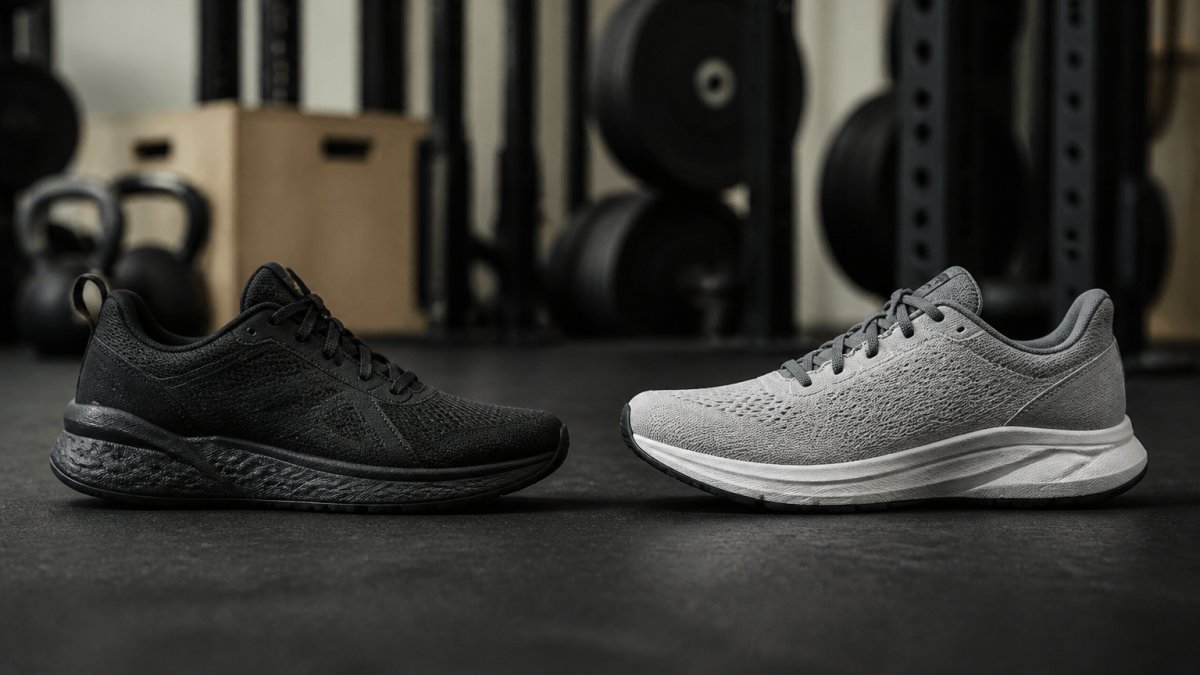
Running shoes prioritize forward motion with cushioning in the impact zone and minimal lateral support. Cross-training shoes build stability with reinforced midsoles, wider bases, and aggressive tread patterns that grip metal, rubber, and concrete.
The choice matters because HYROX is a hybrid event mixing 8 km of running with eight demanding workout stations, each demanding different things from your feet.
What Best Shoes for HYROX Actually Demand
The best shoes for HYROX must handle physical stresses that running shoes weren't designed for.
The 8 km Running Sections
Running accounts for roughly half your race time and distance (pubmed.ncbi.nlm.nih.gov). Running shoes excel here with energy return, responsive cushioning, and proven impact management that reduces fatigue and maintains pace.
Running shoes concentrate cushioning in specific zones, heel, forefoot, and arch, leaving the sides unsupported. This becomes a liability during transitions from sled work into running sections with a fatigued core.
Grip and Traction at Workout Stations
Running shoes fail here. Their shallow tread patterns are optimized for dry asphalt, not for gripping metal or rubber.
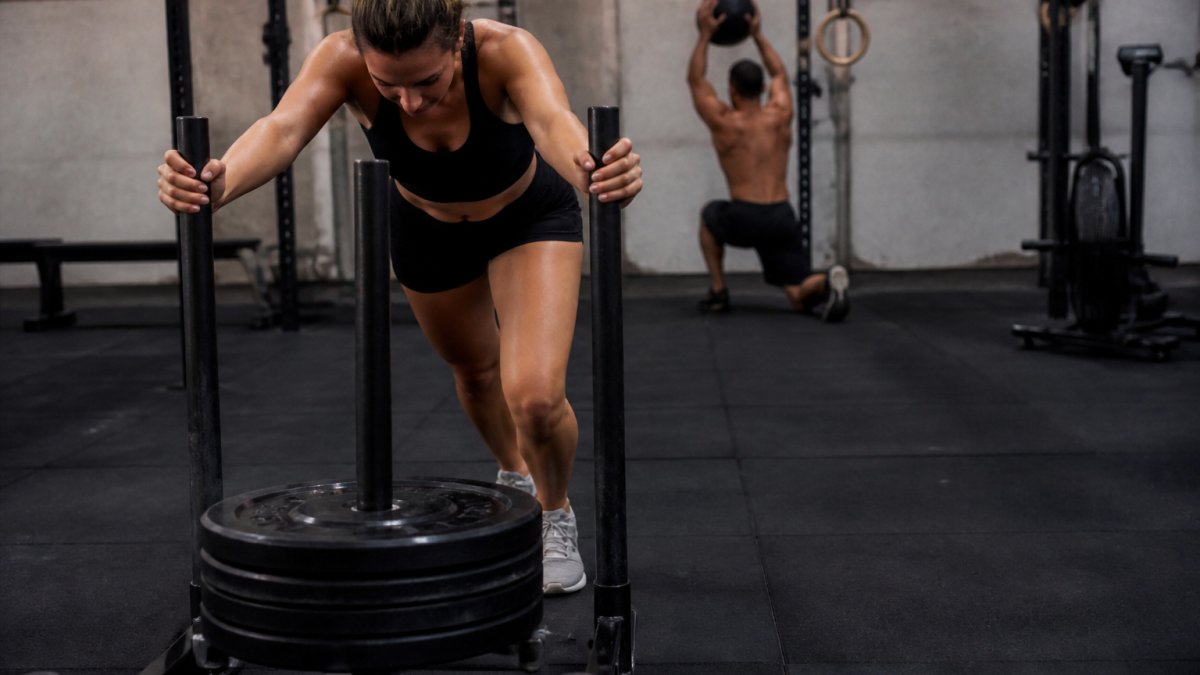
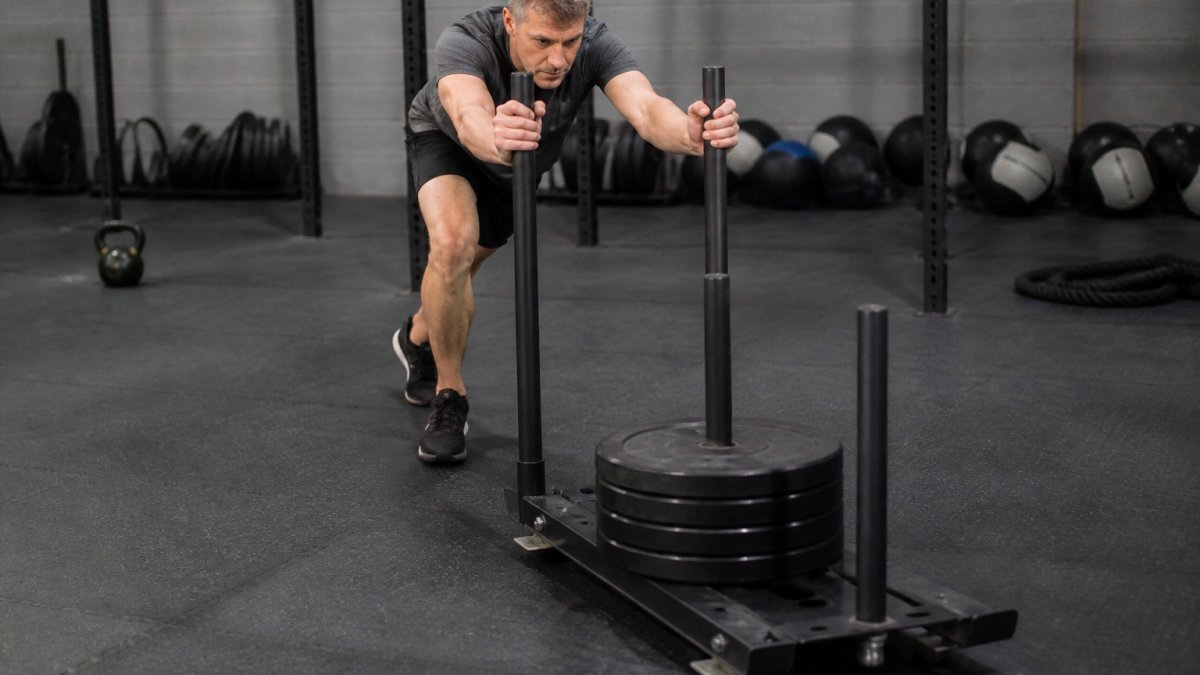
Sled pushes and pulls demand grip from your feet. Cross-training shoes use deeper, aggressive tread that channels liquid away and creates multiple contact points on slick gym floors.
Stability During Strength Movements
Wall balls, burpee broad jumps, and lunges load your foot differently than running. Your foot needs to feel locked in place during these movements. Running shoes allow subtle movement for impact absorption, which becomes a liability during strength work.
Training shoes use reinforced heel counters and stiffer midsoles that resist twisting and keep your foot anchored, critical during lunges where your foot needs to be a stable platform, not a shock absorber.
Running Shoes for HYROX Sled Push and Pull Movements
Running shoes present a real trade-off for sled work: they're light and responsive during running sections but a liability during strength stations where grip and stability matter most.
The Biomechanics of Slipping
When pushing a sled, a running shoe's outsole slips on the platform, forcing a compensation chain: your calf fires to prevent sliding, ankle stabilizers work overtime, hip flexors and glutes recruit to compensate, and your core braces unnecessarily. This exhausts muscles you'll need for running sections.
The sled pull is biomechanically worse than the push. You load your heel heavily while pulling backward, but running shoes have minimal heel tread. Your heel will slip on the pull platform, forcing your hamstrings and glutes to work harder.
Testing Outsole Grip Before Race Day
Test your shoes using three methods: (1) Wet floor test: Apply water to a gym floor and step on it with moderate pressure. Running shoes typically slide 1-2 inches before gripping; training shoes grip immediately. (2) Sled platform test: Practice push and pull movements in both shoe types during high-intensity training when fatigued. (3) Heel-load test: Stand on one leg and shift weight to your heel. Running shoes feel loose; training shoes feel locked.
The Speed-Versus-Stability Math
Some athletes bet on running speed to offset slower station times, but the math rarely works: running shoes gain 2-4 minutes during 8 km of running but lose 1-2 minutes at sled work, 1-3 minutes at other stations, and 30-60 seconds in transitions. The net result is often a wash or a loss for most athletes.
When Running Shoes Might Work
Running shoes can work if you have ankle stability history, train regularly in minimal support, spend extra time on grip-specific drills, accept a slower overall time, and test your shoes on wet surfaces and sled platforms. Those who don't meet these criteria often discover the problem during the race when fatigue worsens instability.
HYROX Shoe Grip: Why It Matters More Than You Think
HYROX shoe grip is a measurable performance factor that changes how your body distributes effort, and grip demands vary significantly across all eight stations.
Grip Demands Across the Eight Stations
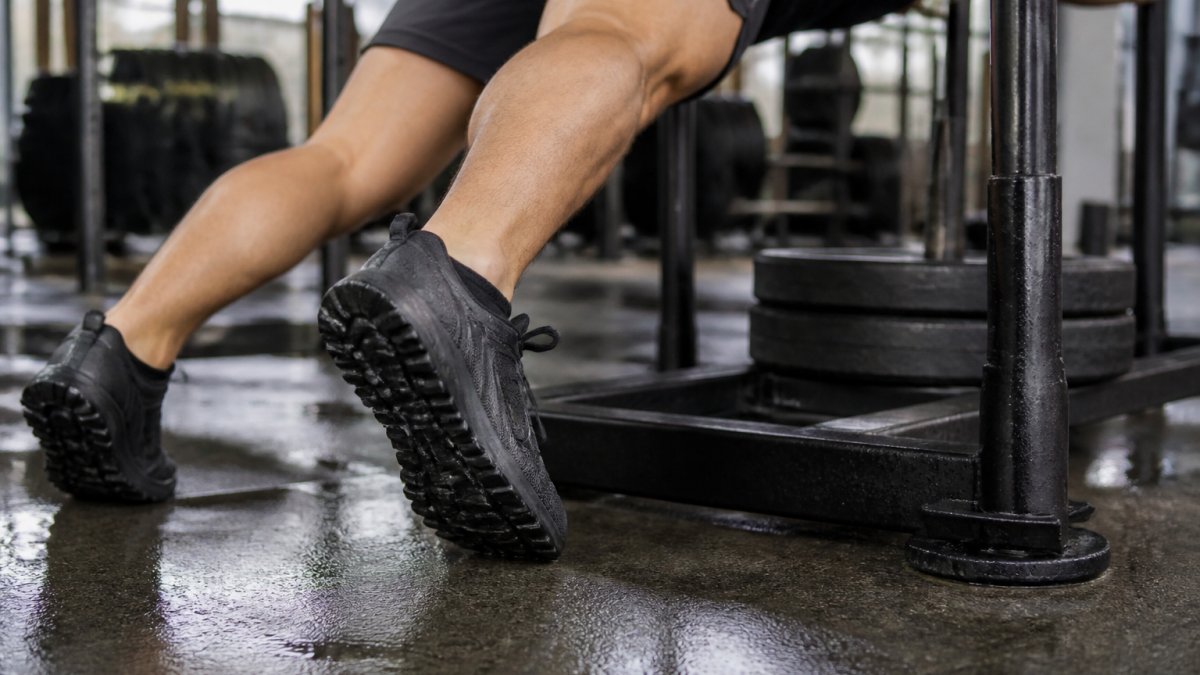
Grip demands vary across stations: Sled push and pull (highest demand) require shoes to bite into wet metal, running shoes fail, training shoes succeed. Wall balls, burpee broad jumps, and lunges (moderate demand) need lateral stability; training shoes provide extra confidence. Rowing (low demand) makes grip irrelevant. Running sections (low demand) work with either shoe type.
How Grip Affects Your Body's Compensation Pattern
When your shoe doesn't grip, your muscles compensate: your calf tightens, ankle stabilizers fire harder, hip flexors and glutes work overtime, and grip strength is wasted. This exhausts the wrong muscles, the ones you'll need for running sections and later stations. By the final running segment, your calves are fatigued and form breaks down.
Testing Grip in Training
Test your shoes after high-intensity conditioning when fatigued. Use the wet surface test (apply water to gym floor and step with moderate pressure), sled platform test (practice push and pull movements), and heel-load test (shift weight to heel). A shoe that feels adequate fresh might feel inadequate after 45 minutes of hard work.
Grip and Confidence
Grip also affects your confidence at stations. A shoe that holds the platform lets you focus on the movement itself. A shoe that slips forces you to think about your feet. That mental load is real. It burns mental energy and increases injury risk because you're not fully present in the movement. Athletes wearing shoes they trust move faster and with better form because they're not second-guessing their footing. (Source: footwear market trends)
Running Shoes: Strengths and Trade-Offs for HYROX
Running shoes bring real strengths to HYROX. They're light, responsive, and engineered for the running sections. They also bring real weaknesses.
Strengths:
- Lightweight design reduces fatigue over 8 km of running
- Responsive cushioning returns energy during running sections
- Proven impact management reduces joint stress
- Familiar feel if you train primarily as a runner
Trade-offs:
- Minimal grip on metal, rubber, or wet surfaces
- Limited lateral stability during strength movements
- Thin, flexible outsoles slip during sled work
- Heel tread is shallow, making sled pulls harder
- Narrow base offers less ankle support during lunges
The fundamental issue is that running shoes optimize for one thing, forward motion on smooth surfaces. HYROX demands optimization for multiple things. A shoe that's perfect for running is compromised at every other station.
Training Shoes: The Hybrid Athlete's Middle Ground
Training shoes exist because athletes like HYROX competitors need something that works across multiple demands. They're not the best at running. They're not the best at strength work. They're the best at being competent at both.
Strengths:
- Aggressive outsole grips metal and rubber surfaces
- Reinforced midsole provides lateral stability
- Wider base supports ankle during movements
- Stiffer heel counter locks your foot in place
- Designed for transitions between different movement types
Trade-offs:
- Heavier than running shoes, which adds fatigue over 8 km
- Less responsive cushioning means less energy return
- Stiffer design feels less natural during pure running
- May require a break-in period if you're used to running shoes
A training shoe is slower during the running sections. You'll feel the extra weight. You won't get the same energy return from the cushioning. But you'll move faster through the stations and transitions. You'll feel more stable. Your form will hold up better when fatigue sets in.
Making Your Choice: A Decision Framework
Your choice depends on three factors: your running background, your strength-to-endurance ratio, and your race goals.
Choose running shoes if:
- You're primarily a distance runner and can handle compromised stability
- Your goal is to run the race as fast as possible and accept slower station times
- You're training specifically to improve your running fitness
- You have excellent ankle stability and don't need external support
Choose training shoes if:
- You're coming from a CrossFit or strength training background
- You want a balanced approach across all eight stations
- Your goal is overall race completion time, not running speed
- You have any history of ankle issues or want extra stability
The middle path: Some athletes train in training shoes but race in running shoes, betting that race-day adrenaline and lighter shoes will overcome the grip disadvantage. This works for some people. It fails for others when fatigue hits and their feet slip during sled work.
At Warrior Welke CrossFit l/Hyrox, we see athletes succeed with both approaches. The runners who choose running shoes typically have exceptional ankle stability and spend extra time on grip-specific drills at the sled stations. The strength athletes who choose training shoes accept that they'll be slightly slower during running but maintain form and speed through the entire race.
| Factor | Running Shoes | Training Shoes |
|---|---|---|
| Running efficiency | Excellent | Good |
| Station grip | Poor | Excellent |
| Lateral stability | Minimal | Strong |
| Weight | Light | Moderate |
| Transition feel | Smooth | Stable |
| Best for | Distance runners | Hybrid athletes |
Common Mistakes When Choosing HYROX Footwear
Most athletes make one of three mistakes when selecting shoes for HYROX.
Mistake 1: Choosing based on comfort alone. A shoe that feels comfortable during a 5 km training run might slip on the sled platform. Comfort and performance are different things. Test your shoes at the stations, not just on the road.
Mistake 2: Prioritizing running speed over everything else. HYROX isn't a running race. The athlete who runs 30 seconds faster but loses 2 minutes at the stations is slower overall. Balance matters more than specialization.
Mistake 3: Not accounting for fatigue. Your shoes need to work when you're tired. Test them during high-intensity training sessions when your feet are already fatigued and your form is breaking down.
A fourth mistake is less common but worth mentioning: choosing shoes based on what other people are wearing. HYROX athletes train with different backgrounds. A shoe that works for a CrossFit athlete might not work for a runner.
Choosing the right shoe for HYROX comes down to understanding what your feet will actually face during the race. Running shoes excel at sustained forward motion but compromise on grip and stability.
If you're training for HYROX and want guidance on shoe selection tailored to your specific needs, our coaches at Warrior Welke CrossFit l/Hyrox can assess your movement patterns and help you make the right call.
Frequently Asked Questions
Can I use regular running shoes for HYROX?
Yes, but with trade-offs. Running shoes excel during the 8 km running sections through superior cushioning and energy return, but they sacrifice grip and stability at workout stations like sled pushes and wall balls. Many athletes successfully complete HYROX in running shoes if they prioritize running performance and accept reduced traction during strength movements. The decision depends on whether your race strategy favors running speed or balanced station performance.
What makes the best shoes for HYROX different from regular training shoes?
The best shoes for HYROX balance running efficiency with grip and lateral stability. They typically feature moderate cushioning (not as plush as pure running shoes), aggressive outsole patterns for traction on wet or muddy surfaces, and stiffer midsoles to support explosive movements. Cross-training and hybrid shoes bridge this gap better than either pure running or pure gym shoes, though true HYROX-specific models optimize for the exact demands of 8 km running combined with repeated strength-based transitions.
Are running shoes or training shoes better for HYROX sled pushes?
Training shoes and cross-training shoes outperform running shoes for sled pushes. Their wider bases, stiffer midsoles, and aggressive tread patterns provide the lateral support and grip needed to push heavy sleds without your foot rolling inward. Running shoes have minimal side-to-side support and smoother outsoles, making them less stable during the explosive drive phase of a sled push. If sled push performance is a priority, training shoes are the safer choice.
Do I really need HYROX-specific shoes, or can I train in what I already own?
You can train effectively in either running shoes or cross-training shoes you already own, many athletes do. HYROX-specific shoes optimize the exact blend of running cushioning and station grip, which can improve comfort and performance over a long race, but they are not essential for training or completing the event. If your current shoes feel stable during strength work and comfortable during sustained running, start training in them. Upgrade only if you experience instability at stations or excessive fatigue during running sections.